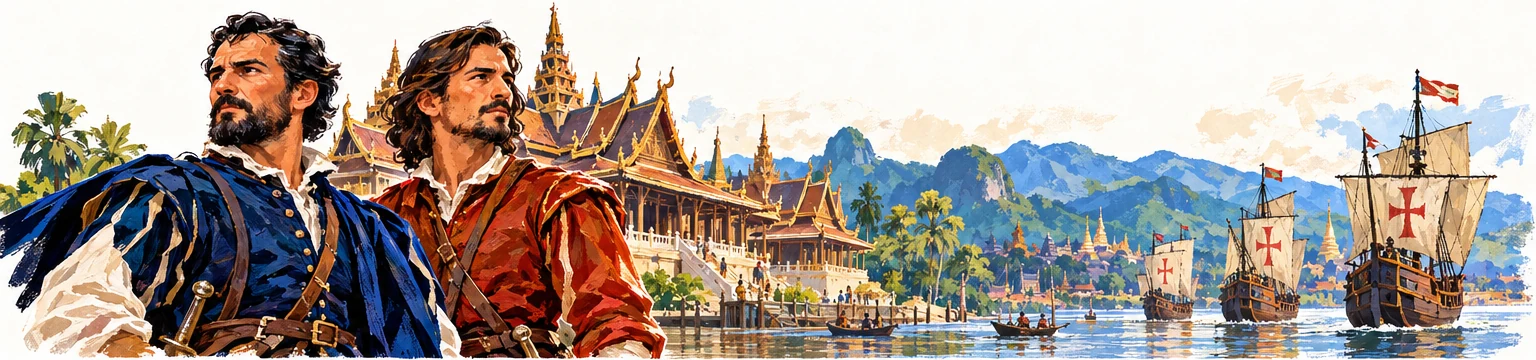
The Arrival in Cambodia
In the late 1500s, Cambodia found itself at the center of competing regional powers and international trade networks. Into this world stepped two unlikely players: a Portuguese adventurer and a Spanish soldier.
Diogo Veloso reached Cambodia through the Portuguese trading world connected to Malacca. During the 1580s he became a familiar figure at the royal court of King Satha, then based at Longvek, Cambodia’s capital. Another Iberian, Blas Ruiz de Hernán González, also entered the king’s circle.
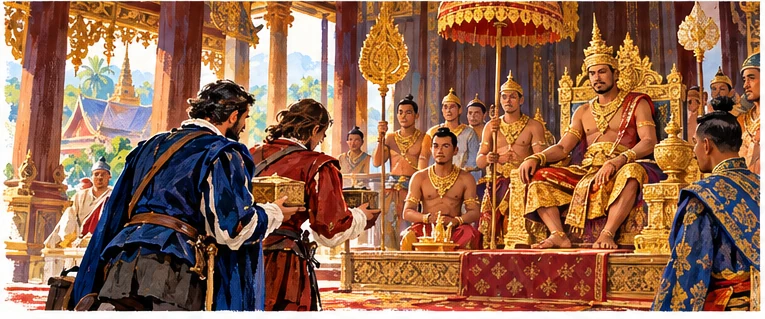
Their position at court grew as Cambodia came under increasing pressure from Siam, centered on Ayutthaya. In 1593, Satha sought military support from Spanish-controlled Manila. Accounts identify Veloso among the intermediaries pressing for help.
What began as diplomacy would soon become entangled with the struggle for the Cambodian throne.
The Fall of Longvek
Before foreign assistance could change the kingdom’s fortunes, Siamese forces attacked Cambodia and captured its capital.
The fall of Longvek, usually dated to 1594 although some accounts give 1593, shattered the authority of King Satha’s court. The king and members of his family fled north to the kingdom of Lan Xang in the region of modern-day Laos.
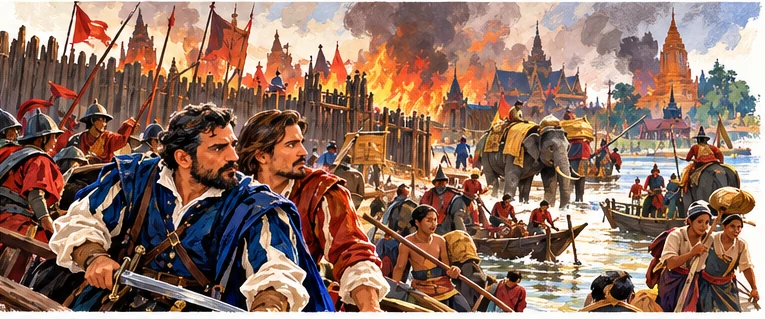
Veloso and Ruiz were caught in the chaos and followed different routes out of Cambodia. They later reconnected with Spanish authorities in Manila, where the prospect of intervention remained alive.
The Spanish Expedition
In 1596, a small fleet finally sailed from Manila toward Cambodia. But the mission was scattered by storms before it could act as a unified force.
The expedition included three ships, Spanish soldiers, religious figures, and Asian auxiliaries. Veloso and Ruiz were among its leading participants. The vessels became separated; some reached Cambodian waters while others were blown off course.
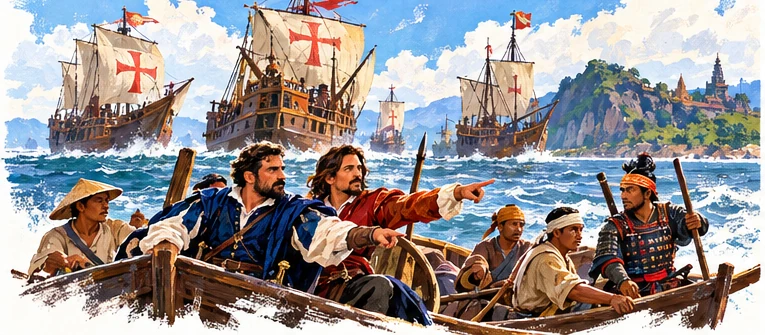
By then, King Satha no longer ruled in Cambodia. Rival claimants and powerful factions competed for influence around Phnom Penh and Srei Santhor. The newcomers became involved in violent clashes, including a royal-palace attack in May 1596 in which the reigning ruler was killed.
Rather than simply restoring a fallen monarch, the adventurers had become armed participants in Cambodia’s internal political struggle.
The Journey to Lan Xang
The two men still hoped to restore King Satha’s line to the Cambodian throne. To do so, they headed north toward the kingdom where the royal family had taken refuge.
Accounts describe a demanding journey involving the Vietnamese coast, difficult overland routes, and the royal center at Vientiane in Lan Xang. On reaching the king’s circle, they learned that Satha had already died.
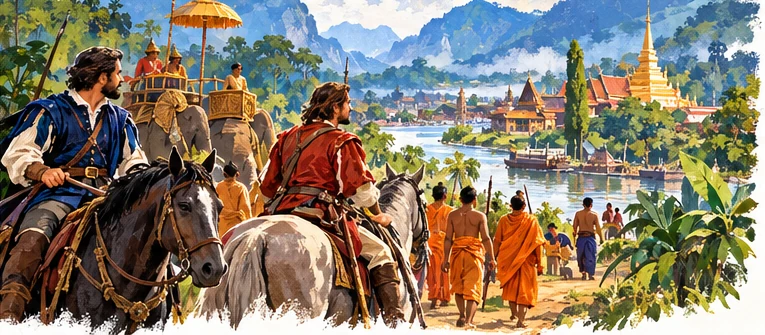
That discovery changed their plans. Rather than abandon the mission, they backed the return of one of Satha’s sons, known in different sources as Barom Reachea or by other royal names. He was restored to Cambodia’s throne during the period 1597–1598, depending on the chronology used.
The journey is often remembered as one of the earliest documented European encounters with the area of present-day Laos. The claim that they were literally the first Europeans there is harder to establish with certainty.
Power, Conflict, and Death
For a brief time, the two foreign adventurers enjoyed extraordinary influence at the Cambodian court. But their position depended on fragile alliances.
Under the restored royal line, Veloso and Ruiz received important territorial or provincial appointments. Their ambitions extended beyond political loyalty: trade access, military influence, and possible Iberian dominance over the lower Mekong all became part of the contest.
Such ambitions provoked opposition. Cambodian nobles, foreign merchants, and influential Malay communities had their own interests, and no single faction controlled the kingdom uncontested.
In 1599, violence erupted between Iberian supporters and their rivals. Fighting in the Phnom Penh area devastated the foreign intervention. Many accounts place the deaths of both Veloso and Ruiz around this conflict, although the precise circumstances—and some details of Veloso’s fate—are disputed.
Two Adventurers at a Crossroads
The story of Diogo Veloso and Blas Ruiz is about far more than the arrival of two Europeans in Cambodia.
They were at once soldiers, envoys, adventurers, and political opportunists drawn into a complex struggle involving Cambodian rulers, Siamese power, Malay trading networks, and the ambitions of Iberian authorities in Southeast Asia.
Their extraordinary journey toward Lan Xang is one of the best-known early accounts of Europeans in the region of modern-day Laos. Their rise and fall at the Cambodian court reveals a kingdom that was not isolated, but deeply connected to the politics and commerce of an expanding maritime world.
More than four centuries later, their exploits remain a revealing episode of post-Angkorian Cambodia—and a reminder that history is rarely as simple as heroes and villains.
A note on the historical record
Sixteenth-century accounts were often written by European participants and chroniclers, and later historians do not always agree on dates, names, motives, or the men’s final fate. This feature follows the broadly documented sequence while marking areas of uncertainty. All illustrations on this page are modern artistic reconstructions, not contemporaneous portraits or documentary scenes.
Further Reading & Sources
This feature brings together accessible historical overviews and academic research. Spelling and royal titles differ across sources.
- The joint Portuguese–Spanish interventions in Cambodia — Spencer Low, The Portuguese in Asia.
- The Coming of the West: European Cambodian Marketplace Connectivity, 1500–1800 — Kenneth R. Hall, in Cambodia and the West, 1500–2000 (2018).
- The Jesuits in Cambodia: A Look into Cambodian Religiousness — Vanessa Loureiro, Bulletin of Portuguese–Japanese Studies.
- Los Españoles en Camboya y Siam: Blas Ruiz y Diego Belloso — Sociedad Geográfica Española, historical account in Spanish.